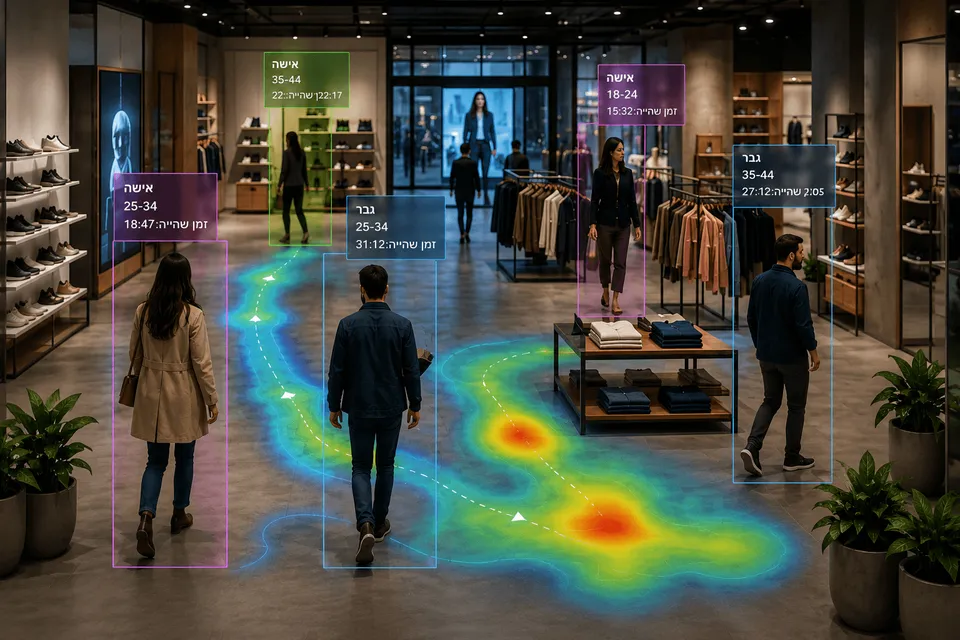
In short: a good people-counting system comes down to six things: accuracy that has been measured (not promised), privacy with no facial recognition, a real POS connection that makes a conversion rate possible, real-time data from every branch, predictable per-branch pricing, and local support. This guide sets out how to check each criterion yourself — and which questions to put to every vendor before you sign.
Why measure visitors at all?
Your POS data only tells you what sold. It does not tell you how many people walked in and left empty-handed, which hours the store is heaving while the sales team can't get to everyone, or who your visitors even are. Without visitor counting there is no way to work out the single most important metric in physical retail — the conversion rate: how many of the people who came in became buyers. Once counting is reliable, every drop in sales gets a diagnosis: fewer people coming in (a marketing and location problem) or fewer buyers among those who did (an operations, staffing or stock problem). Those are two completely different treatments.
The criteria that actually matter
1. How does the system count — and what is its measured accuracy?
The common technologies are optical sensors at the entrance, 3D cameras, Wi-Fi/BLE sensors and infrared beams. The practical differences are large: Wi-Fi sensors miss anyone without a transmitting device and count passers-by outside the store; infrared beams are blocked when two people walk in together. Don't ask a vendor "what is your accuracy" — ask "how did you measure that accuracy, and against what". Credible accuracy is measured against manual counts in real branches, and it accounts for de-duplication: staff going in and out, couriers, and the same customer who stepped out for a minute and came back. A serious vendor will explain exactly how each of those is handled.
2. Privacy: statistical counting or personal identification?
This is a decision point both for regulation and for reputation. A system that performs facial recognition, or follows a specific person over time, brings heavy obligations under privacy law and regulator guidance — and customers do not like it. Counting and demographic breakdowns that are anonymous and statistical (how many came in, an estimated age and gender mix — without identifying anyone) are the safe standard. Ask the vendor for an explicit written statement: is any biometric data stored? Can a visitor's identity be reconstructed? The right answer to both is no.
3. POS integration — without it there is no conversion rate
Counting visitors without transaction data is half a picture. Check that the system integrates with your POS automatically and continuously (not a manual weekly export to a spreadsheet), and ask up front: which POS systems are supported at no cost? How much does building an interface to a different one cost? Who maintains that interface when the POS is updated? An integration that breaks quietly is the fastest route to a dashboard showing wrong numbers.
4. A demographic breakdown you can act on
Basic counting says "480 people came in". A demographic breakdown says "mornings skew older and female, afternoons younger and mixed" — and that already dictates your product mix, your rota and even your local advertising. If you are a chain with different audiences across branches, this is the difference between shipping identical stock everywhere and matching each branch to its own catchment.
5. Real time, alerts and permissions
A monthly report is nice; knowing now that conversion at one branch fell off a cliff this morning is what lets you fix it today rather than in a month's time. Check: does the dashboard update in real time? Are there proactive alerts to mobile and email? And is there permission management, so a branch manager sees their branch while head office sees the full picture and the comparisons between branches?
6. Pricing: look for a predictable model, beware hidden costs
Models in the market range from expensive hardware bought up front (CAPEX) to a monthly subscription per branch. Ask about every component: one-off installation, monthly subscription, POS integration cost, extra users, and what happens when you add branches. A healthy model is one you can work out yourself, in advance, for any growth scenario — if it takes a sales call to find out what one more branch will cost you, treat that as a warning sign.
7. Local service and onboarding
A sensor that fails, a POS that updates, a new branch opening — a measurement system is an ongoing service, not a shelf product. Prefer a vendor with local installation and support, and ask existing customers at your scale about real response times. And check the simplest thing of all: will your team actually use it? A dashboard in their language, automatic summaries by SMS and email, and clear alerts are worth more than ten reports nobody opens.
Questions to ask every vendor — a list for the meeting
- How is your accuracy measured, against what, and does it include filtering out staff and duplicates?
- Is any facial recognition performed, or any biometric data stored? (Ask for the answer in writing)
- Which POS systems are supported at no cost, and what does an interface to another one cost?
- What exactly is included in the monthly price, and what costs extra?
- How long does installing a branch take, and who does it?
- Can we see a live dashboard from a real customer (with their consent) rather than a slide deck?
- What happens to our data if we decide to leave?
Common mistakes worth avoiding
Buying counting without POS integration — you end up with "how many came in" and no "how many bought", which is the less useful of the two. Comparing price per sensor instead of total cost per branch — installation, subscription, interfaces and maintenance are the real picture. Choosing on a slide deck rather than a pilot — one branch for a month or two tells you more than any sales call. And ignoring your team — a system branch managers don't open in the morning will never change a single decision.
And where does EYEZ stand on all this?
Full disclosure: this guide was written by EYEZ (Eyezapp), and the criteria above apply to every vendor — including us. Here is how we answer them: counting with optical sensors at a measured 96% accuracy, with duplicates filtered out; no facial recognition and no personal identification — the demographic breakdown is statistical and anonymous; free integration with Comax, Shopify and Hyp (other POS systems priced by an estimate of development hours); a real-time dashboard with alerts, permissions and branch-to-branch comparisons; and simple per-branch pricing — ₪350 a month up to 3 branches, ₪300 up to 20 and ₪250 above 20, with a one-off installation of ₪1,000 per branch (prices exclude VAT, correct as of July 2026). Today the platform runs in more than 310 retail locations across 44+ chains in Israel, among them Swarovski, Guess and WeShoes.
Want to test us against the list? Book a short demo, or run an estimate through the price simulator on the home page, and you will have an answer quickly — and even if you choose someone else, at least you will have chosen on the right criteria.
The bottom line
Don't buy an entry counter — buy the ability to answer three questions: how many came in, how many of them bought, and why. A vendor who can show you measured accuracy, demonstrable privacy, a live POS connection and transparent pricing passes the screen. Everything after that is a matter of fitting your needs and your budget.